Nupur Paliwal was a guest speaker at this year's MU Scotland & Northern Ireland Annual General Meeting (AGM), which took place on 8 October. The event brought members together to hear updates on the Union's work and meet the regional team. Learn more about the role of AGMs in the Union and read Nupur's inspirational speech to attendees below.
Greetings to the Musicians’ Union! The Students’ Federation of India (SFI) UK began as the first overseas unit of the SFI. Since we were set up in 2022, beginning in Edinburgh, we have been working on issues faced by migrant students in the UK. These often revolve around the cost of living, students’ rights, our rights as part-time workers, concerns on racism and discrimination as well as larger social and political questions.
My attempt at the Scotland & Northern Ireland MU AGM was to share these histories and seek to use them as a link through which we can unite our work, our campaigns to keep music alive. These are undeniably dark times, in social, political and economic terms. As Bertolt Brecht’s saying goes, “In the dark times, will there also be singing?”
Singing about the dark times
“Yes, there will be singing. About the dark times.” Because art and music are the closest we as a collective can get towards universal communication.
As an Indian student who is interested in art, music and culture, Safdar Hashmi’s name can never escape me. Safdar was an Indian playwright, artist, actor, musician and writer. He embodied the link between art and the people’s movement, to him both of these were inseparable. He died in hospital on 2 January 1989, the victim of a deliberate attack. He was murdered while his Janam group was staging a play at Sahibabad, in the outskirts of Delhi—a street play in support of a wage increase for industrial workers. The issues raised in the play were, ironically, the right to speak, the right of the worker to assert his or her identity.
This attack was an attack on free performance—free both in terms of what it cost to mount, and because it was free of external pressures. This was exactly what the trade unions and other left organisations needed, and exactly what the right-wing sought to target.
Today, Janam continues to operate out of a studio, titled Studio Safdar, in the working class neighbourhood of Shadipur in Delhi. But to erect a studio in the very spot and to continue the work of performing Safdar’s play is the most fitting way to honour his legacy and to honour the legacy of progressive artists.
SFI’s music front
The same legacy permeates the way we as SFI operate on campuses. The SFI’s own musical outfit, Dastak, performs songs of a wide variety — people’s folk music, covers, revolutionary songs. Dastak is the organisation’s cultural wing, and also our most visible wing at times. It has the specific aim of engaging students on questions of oppression and resistance in accessible ways.
In the video here, students are singing a song titled, ‘Woh Humaare Geet Kyu Rokna Chahte Hai, Why Do They Want to Halt Our Songs?’
This is targeted at right-wing groups which seek to suppress any kind of forum where their ideas are questioned. In a country like India, where the far-right is firmly embedded in government and forces are polarised, anything that makes people question their ideas is dangerous.
The right to perform
We, as a collective, must protect the right to perform. Janam and Dastak have shown us that performance is under threat, it is not something we can take for granted.
The right to perform is being threatened at social, political and economic levels, both in India and here in the UK.
- Socially: The social and cultural importance of musicians is being corroded. Spaces in the social sphere for musicians are shrinking. MU Assistant General Secretary Matt Wanstall has commented on busking, better than I can. "Public spaces are public spaces. You should be able to busk and you should be able to perform on the street," he said. We have seen this before, freedom of art and expression being curbed in the name of public order. Now, the Public Spaces Protection Order (PSPO) in Coventry, which focuses on the setting up of gazebos and stalls, effectively bans busking in the city centre.
The push to build public auditoriums that are affordable and accessible, performance spaces that cater to the public, is fading because these are not as profitable as concert venues. Every community must have its own libraries, its own theatre, its own art and its own music.
2. Politically: In political terms as well, the right to perform is being curbed. I’ve spoken about Dastak and played this song, but not yet mentioned that many of these very same performers have been brutally attacked by the police in the last few days for claiming the streets to perform songs that question the current state of affairs. There are very serious questions on electoral integrity and democratic rights that the Left in India has been raising. For Dastak, the easiest way to voice these questions is through music. Alas, it is also thus the easiest for the larger public to comprehend and absorb, thus making it the first frontier to be attacked in the state clampdown.
It is at times like this, when the collective union of artists and musicians becomes all the more important. The collective was able to arrive and deem this incident, 'a gross violation of the democratic right of the artists to perform in front of the people'. Street performers are attacked not because they hold up traffic, but because they take up topical issues and raise difficult questions.
3. Economically: The right to perform, for a musician, is synonymous with the right to work. Unemployment and precarious employment affect certain groups much more harshly than others, and this includes musicians, especially those from marginalised backgrounds. If a musician has to juggle between 3 to 4 jobs to keep performing, if they have to survive on half the average national income, then we certainly cannot say that the right to perform has been secured.
The demand for basic income, that we have heard so strongly expressed earlier today, is essentially an assertion of the right to perform. Being forced to perform in economic precarity endangers both the musician and their music.
Working in solidarity
The role of collectives like ours is critical in helping to motivate young students and workers to be active in the trade union movement. We impart values of struggle and solidarity when we go to the middle-class youth and students.
As such we play a kind of spiritual role in the broader democratic movement. However, what makes the Musicians’ Union stand apart is not just the quality of being a trade union, but also the very nature of work that members perform.
Both this work and the workers that produce it have the power to influence our cultural moment. As a progressive students’ organisation, SFI recognizes this and seeks to foster it by building united cultural spaces within our local communities to protect musicians and music that exists outside of the commercialised market. The more external influence we permit into these spaces, in the form of generative AI, third-party event vendors, management consultancies, the less democratic our spaces become.
These spaces are already shrinking. The absence of people’s auditoriums, subsidised performance venues, accessible studios, busking areas, are all indicators of this. This is of direct influence to musicians, but also threatens the local community. These spaces and performances are fertile grounds for migrants, youth, and students to interact and integrate themselves within local culture.
An absence of this only alienates us from each other and feeds into narratives of isolation and division. In the interests of building a progressive community, these are joint concerns that we must campaign jointly on.
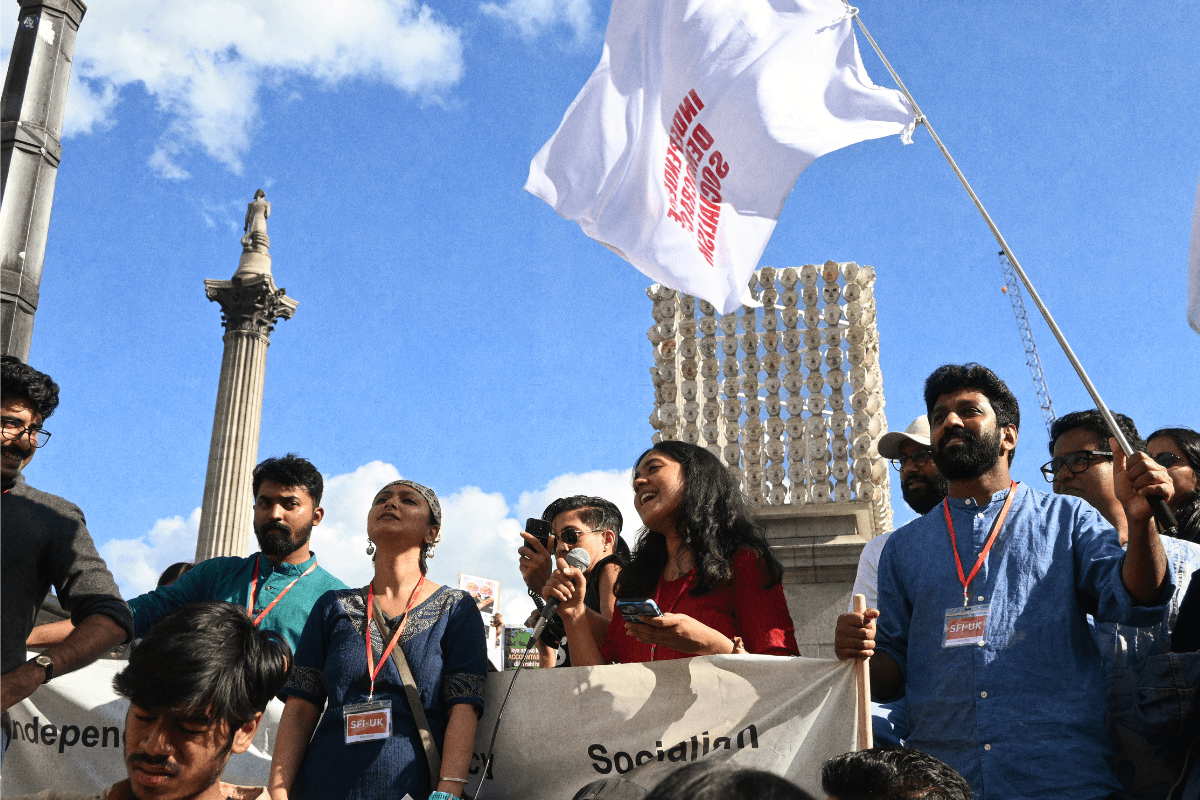
The MU is one of the more vibrant, appealing unions when it comes to young people and students obtaining membership because you have recognised that youth and the desire to seek experience can add more vulnerability to work, that already exists in precarity. Having a trusted trade union that we can direct young students and performers to, is of immense importance to us. There are issues and struggles that we as a voluntary organisation cannot undertake, and in moments like this, forging solidarity across our groups is crucial for us.
We have to keep music alive, we have to keep our music — the people’s music, alive. Every major site of protest or resistance relies on music to echo its message.
In India, Jantar Mantar is singing. Here, Trafalgar Square is singing. Garvaghy Road is singing. We must keep music alive, because it is the only way to keep our resistance alive. And music cannot exist without the musician.
A musician must be liberated to create music that can liberate. This can never be replaced.
We stand together with the Musicians’ Union in this quest for music that liberates.