When we look across the UK at state-funded professional orchestras, publicly supported conservatoires, and formal full-time music education pathways, disabled musicians remain strikingly under-represented.
Research indicates that only around 2% of musicians in Arts Council England–funded ensembles and major national orchestras declare a disability, despite disabled people making up 22% of the UK population. This is not a marginal discrepancy; it is a systemic one. The absence of disabled musicians at the professional level is not due to a lack of talent, ambition, or breadth of skill, but to the cumulative effect of barriers embedded much earlier in the pipeline.
The problem does not start in the orchestra, it starts at Key Stage 4 and the post-16 transition.
Chapman as one example of many
Chapman Shum is a 15-year-old student member of the Musicians’ Union. Due to a rare disease, he was born blind and also lives with severe autism, speech and learning disabilities, and progressive hearing loss. Despite these challenges, he is a highly committed and capable young musician.
Chapman achieved ABRSM Grade 8 Piano with distinction at the age of 11 and was awarded the ARSM Diploma in Piano Performance at 13. He is currently a weekend student at the Junior Department of Trinity Laban Conservatoire of Music and Dance, studying piano with a professor who works with him as a musician first and foremost.
Chapman is not only a classical pianist. He is an active ensemble musician, composer, and improviser. He performs and creates across classical, jazz, folk, contemporary, and improvised music. He is a member of the National Open Youth Orchestra (NOYO) and the London Youth Folk Ensemble, and has developed a particular passion for sound, improvisation, and composition, areas that have become powerful forms of communication for him.
Chapman has represented the UK internationally and won three awards at an international music competition for blind and visually impaired musicians in Taiwan in 2025. He has been featured on The Piano on Channel 4, as well as on national television and radio in the UK and internationally, using these platforms to inspire other disabled young people and challenge assumptions about who music is “for”.
Alongside his performance work, Chapman is an emerging composer, creating original music inspired by everyday sounds, from city noise to natural environments. He has also received multiple awards recognising not only his musical achievements, but his advocacy and contribution to inclusive music-making.
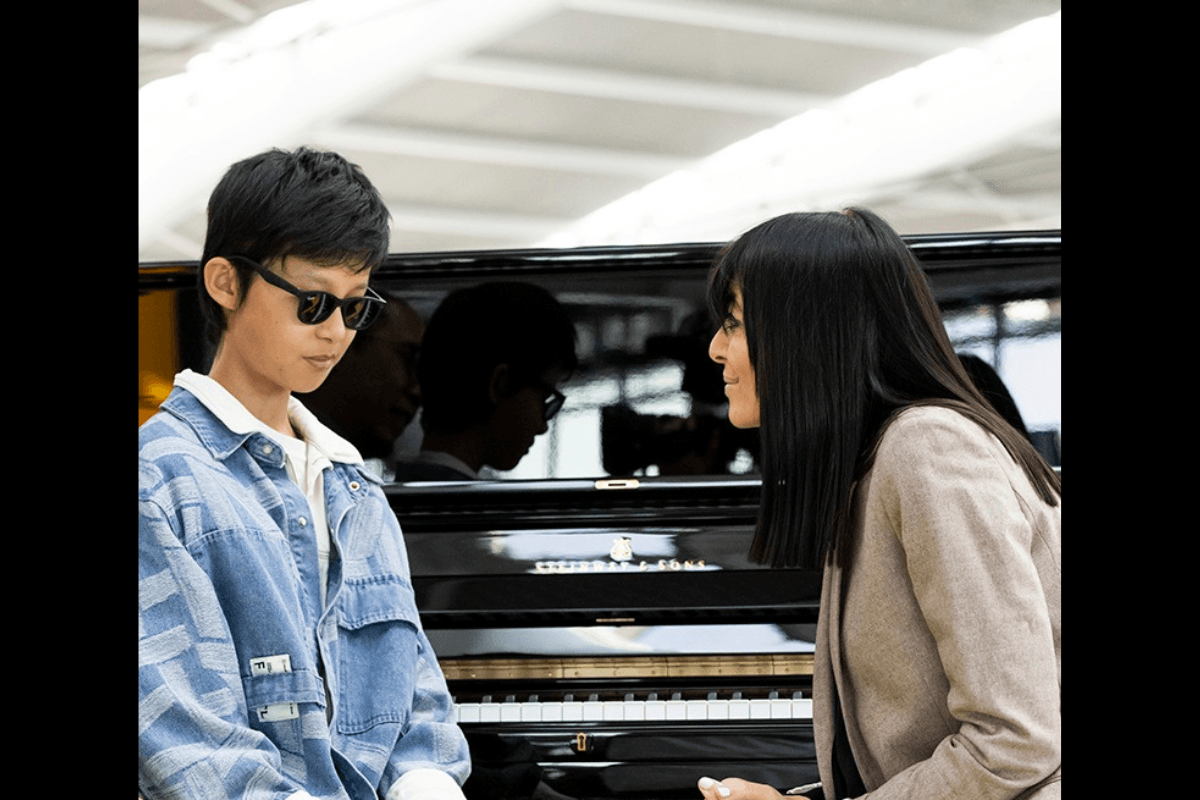 Chapman on Channel 4’s The Piano. Photo: © Love Productions for Channel 4 2025.
Sixth form
As Chapman approaches sixth form, his musical development is accelerating. His full-time educational options, however, are narrowing.
Despite his advanced musical attainment, stylistic versatility, ensemble experience, and international recognition, Chapman is still being excluded from mainstream, music-specialist full-time schools, primarily because he does not hold GCSEs in English and Maths. This is not due to a lack of intelligence, effort, or commitment, but because his complex disabilities make conventional examination routes inaccessible.
The years between 16 and 18 are critical. They are when serious musicians consolidate technique, ensemble experience, theoretical understanding, creative voice, and professional identity. If disabled musicians are filtered out at this stage, it is unsurprising that so few later appear in conservatoire undergraduate cohorts, professional orchestras, or sustainable freelance careers.
When achievement is not enough
Chapman’s situation highlights just how rigid and illogical the current system can be. Although he is not yet 16, Chapman is already undertaking conservatoire-level training at Trinity Laban’s Junior Department. He has passed the ARSM Diploma, a qualification benchmarked at RQF Level 4, broadly comparable to completing the first year of an undergraduate degree. He is also preparing for the LTCL Diploma (Level 6).
Yet despite this, these qualifications still do not allow him access to Level-3 full-time study at a mainstream specialist music school. In musical terms, Chapman is already operating at a level that many specialist sixth forms aim to develop their students towards, not refuse entry from.
He has been told informally that he is “wanted”, but that policy requires applicants to hold GCSEs in English and Maths. The barrier is not musical ability, practice discipline, breadth of musicianship, or professional potential. It is the absence of qualifications that, for a young person with complex disabilities, do not meaningfully reflect learning capacity or intellectual engagement.
To put this into perspective, imagine a young runner who consistently outperforms their age group, demonstrates outstanding athletic ability, and aspires to train and compete internationally. Now imagine that young runner being barred from a specialist sports academy, not because of speed, endurance, or commitment, but because they failed a written theory exam unrelated to athletic performance. No serious sports body would consider this reasonable. Yet this is precisely how the music education system currently operates for many disabled young musicians.
The message this sends is deeply troubling: that even when disabled musicians meet, and often exceed, the musical standards expected in their age group, their achievements can still be rendered invisible if they do not conform to narrow academic frameworks.
Caught between two systems
Families like ours often face an impossible situation. Mainstream music schools may recognise exceptional musical ability, but are frequently unable or unwilling to support students with complex disabilities, even one with exceptional music talent.
On the other hand, special schools, while vital and necessary, are rarely equipped with the specialist staff, facilities, ensemble opportunities, or subject-specific expertise required to nurture advanced musical talent.
There is very little provision in between. As a result, many disabled musicians with genuine professional potential, musicians who can already perform, improvise, compose, collaborate, entertain and inspire others, simply disappear from the pipeline. Chapman is not alone. There are many like him.
Inclusion that unintentionally excludes
The UK has made meaningful progress in inclusive youth music outside the mainstream music school system. Dedicated SEN programmes, inclusive orchestras, targeted funding, and specialist organisations have opened doors that were firmly closed a generation ago. Chapman has benefited enormously from these developments, particularly from environments that value creativity, attentive listening, and collaboration alongside technical skill. However, mainstream music schools have not kept pace with this progress.
It is also worth addressing a common misconception, the existence of inclusive music programmes does not automatically equate to genuine inclusion. Inclusion can unintentionally become another barrier when it is implemented without flexibility or clear progression routes. Too often, disabled musicians are grouped primarily by diagnosis rather than by musical ability, experience, or aspiration. While this approach may provide access at an early stage, it can also impose an invisible ceiling.
Without pathways that allow movement into advanced, mixed-ability, and pre-professional settings, disabled musicians may be welcomed into inclusive spaces yet prevented from progressing beyond them—effectively excluded by inclusion itself.
Without clear routes from SEN provision into advanced, mixed-ability, and pre-professional settings, talented disabled musicians may be welcomed into inclusive spaces yet quietly excluded from pathways leading to conservatoires, higher education, and paid professional work.
In music, progression matters. Repertoire difficulty, ensemble standard, rehearsal intensity, stylistic breadth, and performance expectations all shape whether a young musician can realistically imagine a future in the profession. When these elements are withheld, however unintentionally, ambition becomes difficult to sustain.
What could change
From a parent’s perspective, several practical changes could make a substantial difference:
- Flexible post-16 entry criteria for music-specialist education, recognising musical attainment and professional readiness alongside academic qualifications.
- Bridging pathways between SEN provision and advanced music training, rather than parallel systems with no exit routes.
- Recognition of alternative evidence of literacy, numeracy, and learning capacity where standard examinations are not appropriate measures.
- Clear progression routes from inclusive youth ensembles into pre-professional and professional environments, with active institutional support.
- Dual enrolment models, allowing students to study full-time at a music school while receiving SEN-specific support (such as Braille, rehabilitation, or therapy) through specialist provision.
None of this lowers standards. On the contrary, it ensures that standards are applied to musicianship itself, rather than to criteria with limited relevance to professional musical practice.
A future where music is truly open to all
The hope is simple. Like many other disabled musicians, Chapman wants to be a musician like anyone else, one who studies, practises, improvises, composes, collaborates, performs, and contributes meaningfully to the musical life of the UK. Yet even with his level of achievement, he stands at risk of being excluded from the very systems designed to develop professional musicians.
If the system cannot find room for a blind, neurodivergent young musician with proven discipline, versatility and professional ambition, then the question is not “why there are so few disabled professional musicians.” The real question is: How many have we already lost, and how many more are we prepared to lose?
Today, we can no longer imagine a world in which music belongs only to an elite social class, as it once did centuries ago. It is time to imagine a future in which music training is truly open to all who wish not only to hear music, but to learn it, shape it, and make it their own.
This article is published with Chapman Shum’s permission. For more information about his musical work, please visit Instagram.